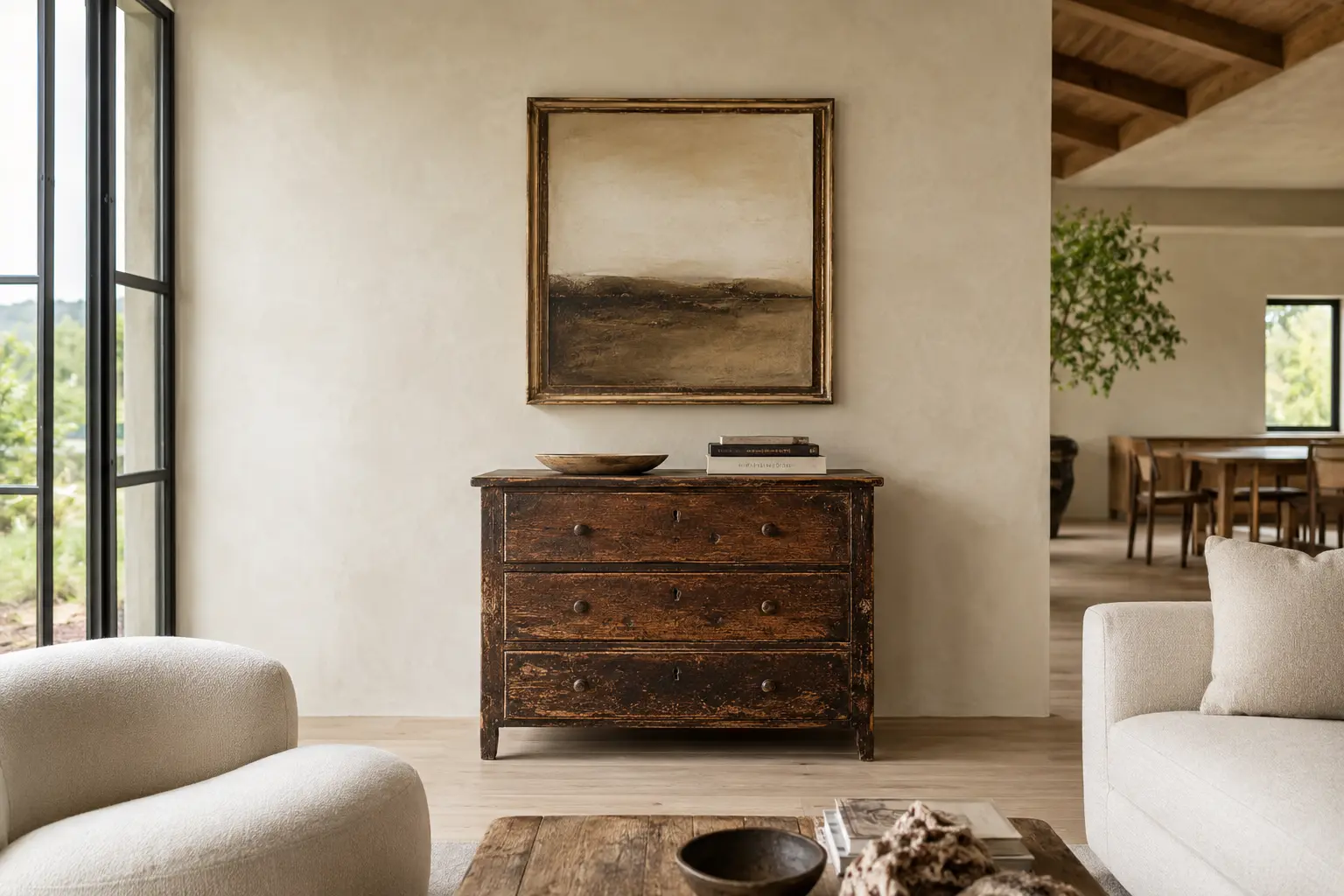
New rooms often look their most finished before they feel their most personal. The lines are clean, the upholstery is fresh, and everything coordinates—but the room may still lack the irregularity that makes it memorable.
One older piece can change that. It introduces age, evidence of use, and a material honesty that gives newer pieces something to play against.
Old does not have to mean formal
An antique chest is wonderful, but so is a worn stool, an old breadboard, a framed sketch, or a ceramic bowl with an imperfect glaze. The piece does not need a pedigree. It only needs character.
Look for useful objects first. A vintage table can hold a lamp. An old crock can gather kitchen tools. A small bench can move wherever an extra seat is needed.
Let contrast do the work
Place the old piece near something clean and modern. A dark wood table beside a pale linen sofa feels more alive than either would alone. A traditional frame around abstract art creates tension without making the room feel themed.
Avoid matching every older object to the same era. The goal is not to recreate a period; it is to let different moments coexist naturally.
Accept evidence of use
Small scratches, softened edges, and variation in color are often what make an old piece appealing. Clean and repair what is necessary, but do not erase every sign of age.
Patina is not neglect. It is the record of handling, sunlight, and time. In a room filled with smooth new surfaces, that record brings welcome depth.
Buy slowly and locally when you can
Estate sales, vintage shops, flea markets, and family attics reward patience. Measure the space, keep a short list of useful categories, and wait for the piece that feels specific rather than merely available.
You may not know exactly where an object will live forever. That flexibility is part of the pleasure. The best old pieces migrate through a home and keep finding new uses.
Keep the story, even if it is small
If you know where the piece came from, write it down. If you do not, let the story begin with you: where you found it, what caught your eye, and how it changed the room.
Something old reminds us that a home is not a single finished picture. It is a collection of years, people, and decisions—still unfolding.