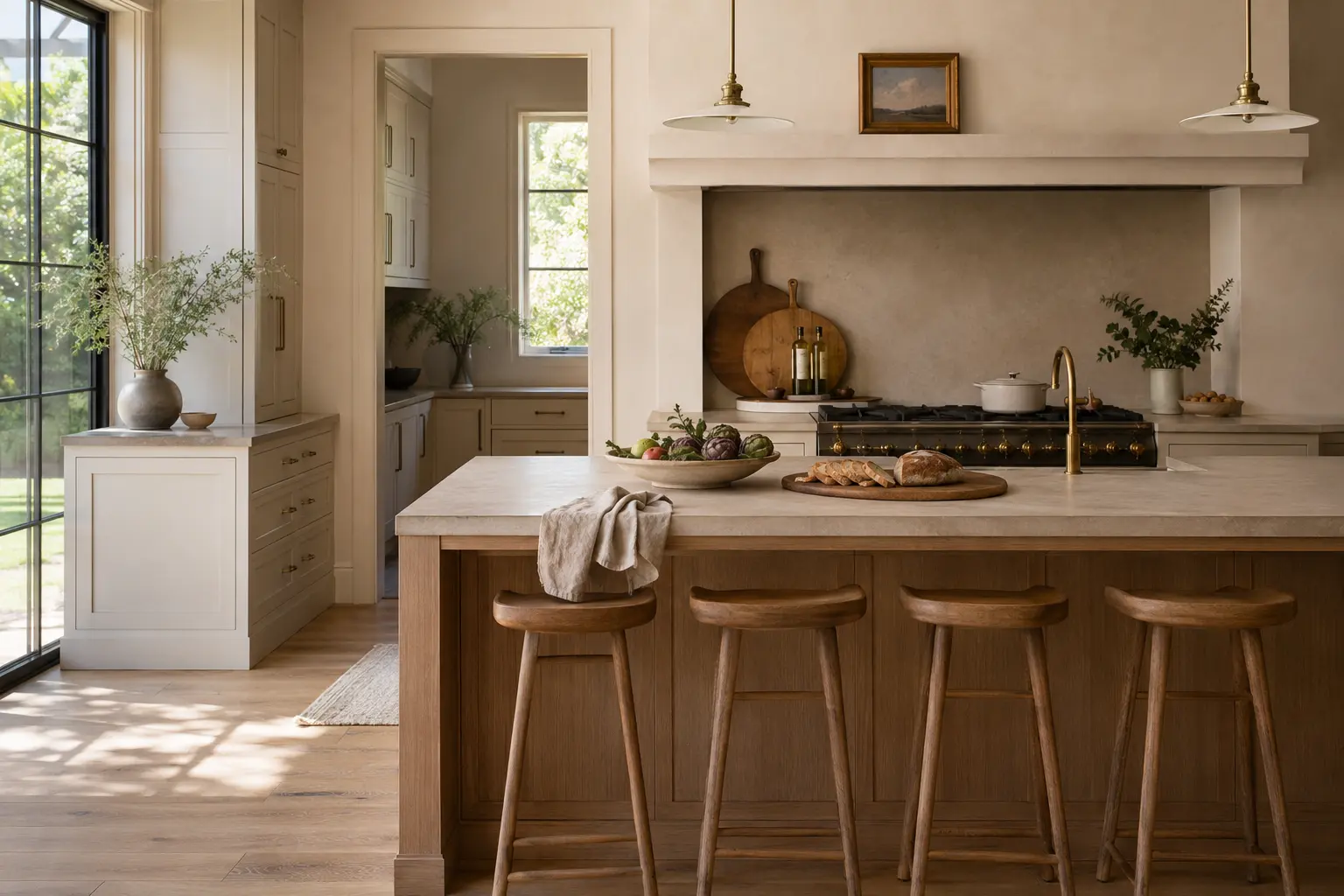
Some kitchens encourage you to move efficiently through a task. Others make you want to stay. They offer a comfortable place to lean, a pool of warm light, and enough openness for conversation to continue while dinner comes together.
A lingering kitchen can be large or small. What matters is that it supports both the work of cooking and the pleasure around it. The best details are often practical ones made just a little more generous.
Give people a place that is close—but not in the way
A counter stool, a small chair near the window, or the end of a table gives company an obvious landing place. Position it near enough for conversation but outside the path between the sink, stove, and refrigerator.
When people know where to settle, the cook does not feel crowded and guests do not feel as though they should disappear into another room.
Use light to soften the working surfaces
Task lighting is essential, but it does not have to be clinical. Layer pendants and under-cabinet light with a small lamp on a counter or shelf. In the evening, that lower glow makes the kitchen feel connected to the rest of the home.
Choose warm bulbs and shades that diffuse the light. A kitchen becomes more inviting when not every corner is equally bright.
Let useful things add character
Keep the tools you use most within reach and choose containers that deserve to stay visible. A heavy wood board, a crock of spoons, a bowl of lemons, or a stack of linen towels brings warmth without decorative clutter.
Open storage works best when it is selective. Display the pieces that are beautiful because they are useful, then give everything else a proper home behind a door.
Create one easy ritual
Perhaps it is a coffee station that makes mornings smoother, a tray ready for evening drinks, or a low drawer where children can reach their own cups. Small rituals make a kitchen feel personal because they reflect the life happening there.
Design for the repeated moment, not the imagined occasion. The everyday routine will shape the room far more than the dinner party that happens twice a year.
Keep the table ready for ordinary life
If the kitchen includes a table, resist treating it as a display surface. A simple bowl or low vase is enough. Leave room for breakfast, homework, a neighbor’s coffee, or a last-minute meal.
A kitchen made for lingering is not always spotless. It may hold a cutting board, an unfinished glass, or evidence of the meal just shared. That is not a failure of the room. It is the reason the room exists.